Futures Prop Firm Education
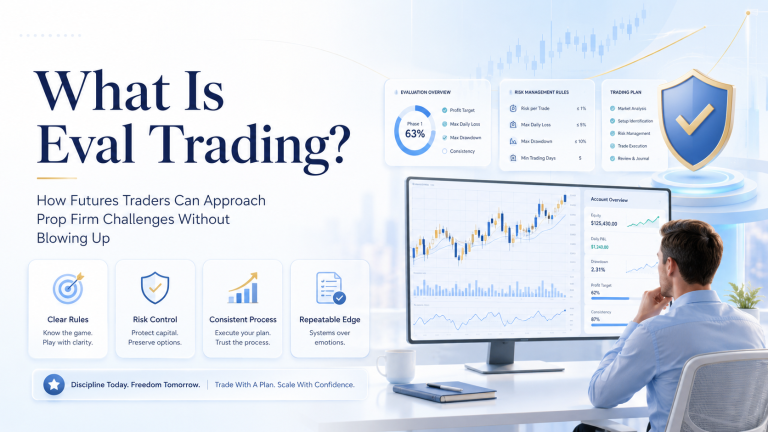
What Is Eval Trading? How Futures Traders Can Approach Prop Firm Challenges Without Blowing Up
Eval trading gives futures traders a way to prove they can follow rules, manage risk, and generate consistent results inside a prop firm evaluation. But most traders fail because they treat the challenge like a race instead of a structured decision-making process.
What Is Eval Trading?
Eval trading, short for evaluation trading, is the process of trading under a prop firm’s rules to prove that you can manage risk, follow a plan, and reach a profit target without violating drawdown limits.
In futures trading, eval accounts are popular because they allow traders to pursue funded account opportunities without depositing a large personal trading account. The problem is that many traders approach evaluations with random indicators, emotional entries, and no repeatable system.
That is why structured trading systems matter. They help traders make clearer decisions, avoid low-quality setups, and stay disciplined when the market gets fast.
What Is Eval Trading?
Eval trading is the process of trading an evaluation account offered by a proprietary trading firm. The trader must usually reach a profit target while staying within strict rules, such as maximum drawdown, daily loss limits, position size restrictions, and minimum trading day requirements.
These evaluations are especially popular among futures traders because futures markets provide high liquidity, leverage, and fast-moving intraday opportunities.
But eval trading is not just about making money. It is about making money while following rules.
A trader who makes one big winning trade by overleveraging may feel successful for five minutes. But if that same trader violates the drawdown rule the next day, the evaluation is over.
In eval trading, discipline matters as much as direction.
Why Most Traders Fail Prop Firm Evaluations
Most traders fail prop firm evaluations because they treat the challenge like a sprint.
They see the profit target and immediately start thinking, “How fast can I get there?”
That mindset is dangerous because it encourages the exact behavior that destroys evaluations:
- Increasing contract size too quickly
- Chasing trades after the clean entry is already gone
- Revenge trading after a loss
- Taking setups outside the plan
- Ignoring market condition
- Trading because of boredom, frustration, or fear of missing out
- Trying to recover losses in one trade
The real problem is not just bad entries. The deeper problem is that many traders do not have a repeatable structure for deciding when to trade and when to stay out.
Without structure, every candle looks like an opportunity. Every pullback looks like an entry. Every move that gets missed feels personal.
That is how traders start forcing trades. And in a prop firm evaluation, forced trades are expensive.
Why Emotional Trading Destroys Funded Account Attempts
The biggest threat in eval trading is not always the market. Many times, the biggest threat is the trader’s own emotional state.
When a trader enters an evaluation, the pressure changes. The account may be simulated, but the emotions are real. The trader wants to pass. The trader wants the payout. The trader wants to prove something.
That pressure can turn a normal trading day into an emotional battlefield.
A small loss feels like failure. A missed trade feels like punishment. A winning trade creates overconfidence. A losing streak creates desperation.
- They move stops.
- They enter late.
- They add to losing positions.
- They take trades they would normally skip.
- They keep trading after they are mentally finished.
This is why emotional trading is so destructive in funded account attempts. The trader is not just making one bad decision. The trader is allowing emotion to control the entire process.
That is why a trader going through an evaluation needs more than confidence. They need structure.
Why Random Indicators Are Not Enough
Many traders try to fix their trading problems by adding more indicators to the chart.
One moving average becomes two. Then comes RSI. Then MACD. Then VWAP. Then support and resistance. Then order blocks. Then fair value gaps. Then some random “secret” indicator from social media.
Eventually, the chart looks more complicated, but the trader is not actually making better decisions.
An indicator shows information. A system tells the trader how to interpret that information and what to do with it.
Without a system, indicators can create more confusion. One tool says buy. Another tool says sell. Another says wait. The trader ends up guessing anyway.
That is especially dangerous in fast-moving futures markets like NASDAQ futures or S&P futures, where hesitation, late entries, and emotional overreaction can punish traders quickly.
Random indicators may make a chart look professional, but they do not automatically create discipline. Eval traders need something more structured.
Why Structured Trading Systems Matter
A structured trading system gives the trader a repeatable framework.
It helps answer one of the most important questions in trading:
What should I be doing right now based on what the market is actually showing me?
That does not mean every trade will win. No serious trading system wins every trade. But a structured system helps reduce emotional decision-making by giving the trader a consistent way to evaluate opportunity, risk, and market condition.
A proper system should help the trader identify:
- Market direction
- Momentum shifts
- Exhaustion zones
- High-quality trade locations
- Low-quality market conditions
- When a setup is aligned
- When to stay out
Most traders do not fail evaluations because they missed one good trade. They fail because they took too many bad ones.
A structured system gives the trader permission to wait. And in eval trading, waiting can be a serious edge.
Need a More Structured Way to Trade Futures?
The Algo Trader builds algorithmic trading systems for futures traders who need clearer decision-making, better structure, and a repeatable process inside fast-moving markets.
Instead of relying on random indicators or emotional chart reading, explore systems built around specific market conditions and trading workflows.
How The Algo Trader’s Systems Help Futures Traders
The Algo Trader’s systems are designed for futures traders who need structure, clarity, and repeatable decision-making.
The current system lineup includes:
Built for Meaningful Market Movement
Designed for traders who want to identify larger, more meaningful market movement instead of getting trapped in noise. It helps traders approach trend development with more structure and confirmation.
Built for the Morning Window
Designed around the early trading window, one of the most active and opportunity-rich periods of the futures trading day. It helps traders use a structured workflow instead of randomly chasing the open.
Built for Bigger Intraday Opportunities
Designed for traders who prefer patience, structure, and larger intraday opportunities. Instead of trying to scalp every wiggle, it helps traders focus on higher-quality movement.
Built for Rotational Market Behavior
Designed for cycling or range-based market conditions. It helps traders understand when the market is rotating instead of aggressively trending.
The Full Bundle gives traders access to the complete system suite: Elephant Hunter, Opening Bell, Whale Hunter, and Cycle Hunter.
You can learn more about the complete system lineup here: The Algo Trader Systems Hub.
The Real Goal Is Not Just Passing the Evaluation
A lot of traders think the goal is to pass the challenge. But passing is only step one.
The real goal is to become the kind of trader who can keep the funded account after passing.
A trader who passes by gambling usually loses the funded account the same way. But a trader who passes by following a structured process has a stronger foundation for long-term consistency.
- If the trader is impulsive, the evaluation will reveal it.
- If the trader cannot manage risk, the evaluation will reveal it.
- If the trader is guessing, the evaluation will reveal it.
- If the trader needs perfect conditions to stay disciplined, the evaluation will reveal it.
The prop firm challenge is not just testing a strategy. It is testing the trader’s behavior.
Eval Trading Rewards the Trader With the Clearest Process
Eval trading can be a powerful opportunity for futures traders, but it is not a shortcut around discipline.
Most traders fail because they enter the challenge with emotional habits, random chart tools, and no repeatable decision-making process.
They are trying to pass a rules-based challenge with a reaction-based mindset. That usually ends badly.
A better approach is to build structure first.
- Know what you are looking for.
- Know when the market condition supports the trade.
- Know when to wait.
- Know when the setup is not there.
- Know when emotion is starting to take over.
The Algo Trader’s systems are built for futures traders who want to approach the market with more clarity, more discipline, and a more repeatable framework.
Because in eval trading, the trader who survives is not always the one who takes the most trades. It is usually the one who makes the clearest decisions.
Ready to Trade With More Structure?
Explore The Algo Trader’s futures trading systems and see how a more organized framework can help you approach prop firm challenges with better decision-making.